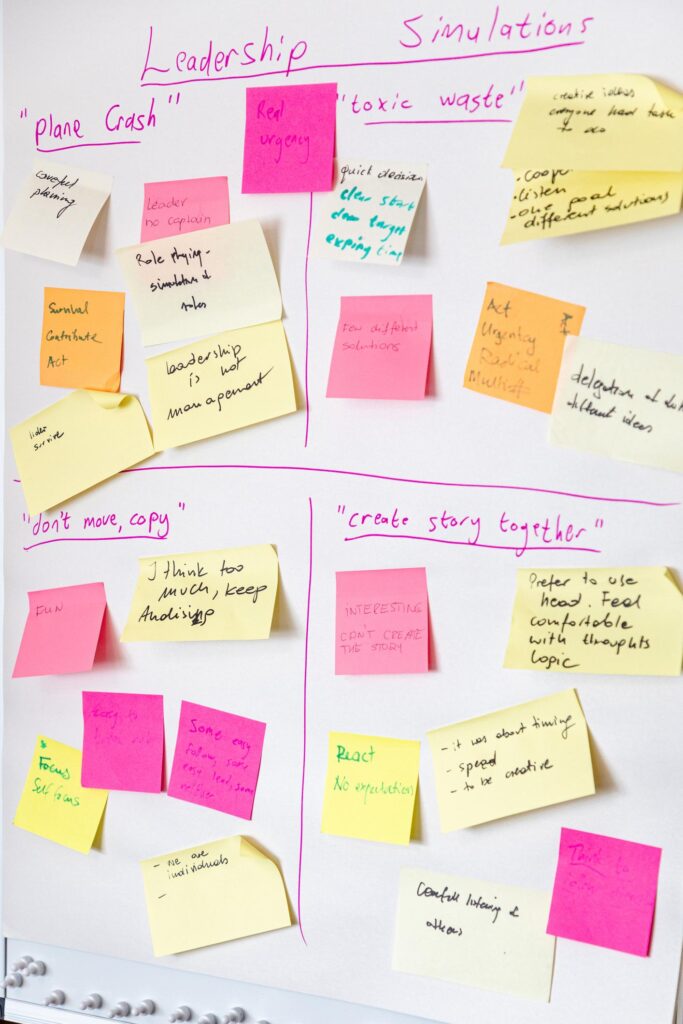
We’ve all sat through them. Someone books an hour. A whiteboard appears. A few sticky notes go up. One confident voice fills the silence. Everyone else edits their thoughts before they speak. We leave with a handful of safe ideas and call it productive.
Then we quietly go back to doing what we were doing before.
The problem isn’t brainstorming. The problem is how we run it. The fundamentals of effective brainstorming have been around for decades, yet most sessions ignore them completely. If you want fresh thinking rather than polite agreement, the conditions in the room matter more than the tools on the wall.
The first shift: stop filtering ideas before they exist
One of the core principles is deceptively simple: every contribution is worthwhile. That includes the weird ones. The half-formed ones. The ideas that make people laugh. In fact, those are often the most useful because they push thinking beyond the obvious.
When people feel they need to sound sensible, they default to what already feels safe. That’s not creativity, that’s compliance dressed up as participation.
Original ideas rarely arrive polished. They arrive messy, awkward, and slightly uncomfortable. That’s a feature, not a flaw.
The rule everyone agrees with and immediately breaks
Suspending judgment sounds easy until you try it.
No evaluating.
No “yes, but…”.
No subtle facial expressions that say everything.
No, quietly deciding your idea isn’t good enough to share.
The moment evaluation enters the room, risk disappears. People retreat to safer territory. The loudest voices continue; the quieter thinkers switch off. Brainstorming isn’t the time to decide what works. It’s time to see what exists. Sorting comes later.
Why structure actually helps creativity
It might feel counterintuitive, but creativity thrives within clear boundaries. Agree on the process before you begin. Run it. Review it afterwards. But don’t change the rules halfway through because it feels messy or uncomfortable.
That messy middle is where the interesting thinking lives. If you stop to tidy it up too soon, you lose momentum and slip back into analysis mode, a completely different mental gear.
This thinking isn’t new
Alex Osborn, who formalised brainstorming in the 1950s, argued for wild ideas, zero evaluation, quantity over perfection, and building on each other’s thinking. Later thinkers echoed the same themes: reduce criticism, encourage free thinking, combine ideas, and create enough structure to keep things moving.
Different words, same truth: creativity needs safety and momentum more than it needs polish.
When the room feels stuck, change the lens
Sometimes a group struggles because everyone is trapped inside their own perspective.
One way around that is rolestorming, asking people to generate ideas as someone else. A customer. A competitor. A fictional character. Someone senior who isn’t in the room.
People suddenly say things they wouldn’t normally risk saying, because it’s not “them” speaking. It loosens thinking in a way logic rarely can.
Another powerful twist is reverse brainstorming: instead of asking how to achieve the goal, ask how to guarantee the worst possible outcome.
How would we design the most frustrating service imaginable?
How could we make this product unusable?
How would we ensure customers never come back?
It sounds backwards, but it works. People often find it easier to critique than create. Once the “worst possible” list exists, flipping it reveals what actually matters.
The facilitator’s real role
If you’re running the session, your job isn’t to stand politely by the flipchart. Your job is to protect the space. That means noticing when judgment creeps in. Gently stopping evaluation. Keeping energy moving. Holding the time boundaries. Making it safe to sound a bit daft.
If the session feels slightly chaotic, you’re probably doing it right.
If it feels neat and efficient, you may have skipped the creative part entirely.
Why this matters at work
Most teams rush straight to solutions. We prioritise, refine, and decide before we’ve properly explored what’s possible.
It feels efficient. It isn’t. It’s premature certainty.
Brainstorming done well widens the field before narrowing it. It creates space for ideas that wouldn’t otherwise surface.
If you want predictable thinking, you don’t need brainstorming.
If you want something genuinely new, you have to tolerate a little discomfort, a little mess, and a few ideas that initially sound ridiculous.
That discomfort isn’t a sign something’s gone wrong.
It’s a sign people are finally thinking.