You know the moment. A decision gets summarised, someone asks “everyone happy?”, there’s a brief pause, a few nods… and the meeting moves on.
Two weeks later, the decision starts to wobble.
Not because people loudly disagreed, but because they never truly supported it in the first place.
This is the gap the Gradients of Agreement help close. It gives teams a way to show how they really feel about a decision without forcing everything into a yes/no box.
Why silence gets mistaken for alignment
Most teams aren’t afraid of conflict. They’re wary of friction. People stay quiet because they don’t want to slow things down, they’re unsure how strongly they feel, or they assume the decision has already been made. The result is polite compliance rather than real commitment, and that tends to surface later as resistance, rework, or quiet disengagement.
The Gradients of Agreement make that hidden layer visible.
So what is it, really?
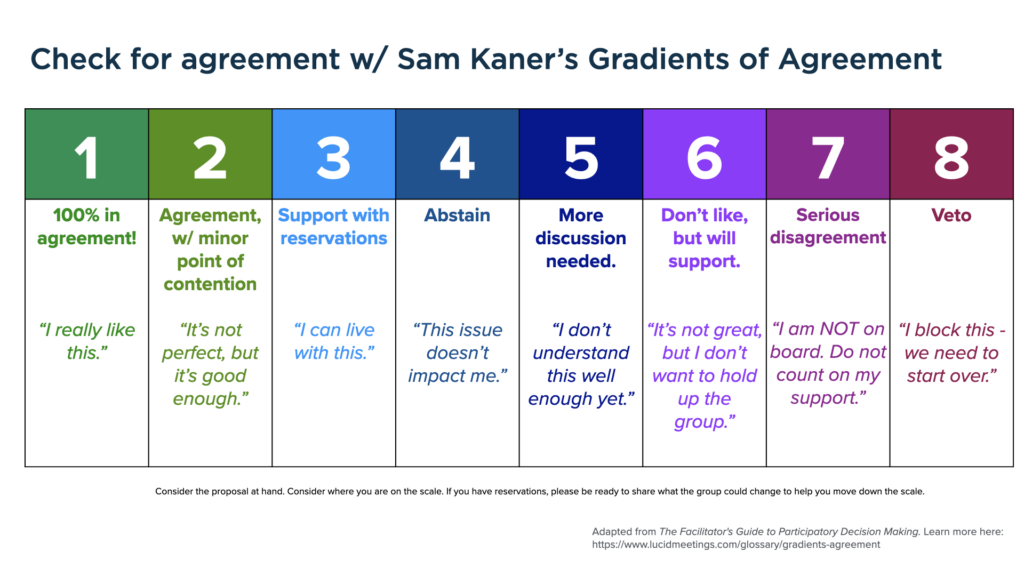
Instead of asking whether people agree, you ask where they stand on a scale, usually from 1 to 8, that reflects the strength of their support.
At one end, someone might say they love the idea. Moving along the scale, others may support it with reservations or feel neutral because it doesn’t affect them. Further along, you’ll see signals that more discussion is needed, or that someone doesn’t like the direction but will support the group. At the far end sits serious disagreement or even a veto.
Most decisions live in that messy middle. That’s exactly why the scale works.
What changes when you use it
You stop guessing.
Instead of assuming alignment, you can see whether support is strong, cautious, or fragile. A room full of quiet “I’ll go along with it” is very different from a room full of genuine backing, even if both appear harmonious on the surface.
The spread of responses tells a story. Strong clustering at the supportive end suggests momentum. A middle-heavy spread often signals unanswered questions. Higher-end scores point to risks that will likely surface later if ignored.
The aim isn’t unanimous agreement. It’s an informed commitment.
Using it without making it awkward
This doesn’t need to feel like a workshop exercise. It works best when introduced simply and matter-of-factly.
Start with a clearly worded proposal. Make sure everyone understands what’s being suggested before opinions come into play. Once the wording is settled, explain the scale in plain language and ask one straightforward question: “Where do you stand on this?”
Capture the spread so the group can see it.
It’s worth saying out loud that this isn’t a vote. You’re looking at the level of support, not making the decision yet. That reassurance lowers defensiveness and encourages honesty.
Reading the room properly
If most responses sit at the supportive end, you’ve got genuine momentum. When responses cluster in the middle, people may go along with the decision but carry concerns that could resurface later. If several land toward strong disagreement, something important hasn’t landed, and pushing ahead will likely cost time and trust. A veto isn’t drama, it’s a boundary signal that deserves attention.
Where it earns its keep
This approach proves especially useful when decisions cut across teams, involve difficult trade-offs, or change how people work. It’s equally valuable when the room feels polite but uneasy, and you can’t quite name why.
Often, a few minutes spent surfacing perspectives saves weeks of friction later.
A small but important caution
If the decision is already made, don’t pretend otherwise. Inviting honest input and then ignoring it erodes trust quickly.
Used with genuine curiosity, though, the Gradients of Agreement shifts something important. It turns passive agreement into ownership and gives people a chance to shape what they’ll later be asked to support.
The real shift
The power isn’t in the scale itself. It’s in what you’re signalling:
Your perspective matters before we commit.
Next time you’re about to ask, “Everyone happy?”, try asking where people actually stand. You might uncover the conversation that saves the decision.